

IQ vs EQ
On the importance of embodying what we say.

Before we dive in, just want to give a heads up that the content touches on the topic of SA and predatory behavior. It’s high level and not detailed, but I know the world is heavy right now. So if you need to skip this weeks post, please feel free to take care of yourself!
Many many years ago, I was caught in a stressful situation at school: one of my favorite teachers ended up being a weirdly predatory man, and was hooking up with one of the students.
It was awful. The kind of experience that really breaks your sense of trust in people. It included every cliché in the predatory handbook: The teacher everyone adored. His kindness and intellect, hiding ill intentions.
The entire situation left my head spinning, and I was trying my best to make sense of it all. How can immoral people articulate such profound truths? How could you understand ethics well enough to teach about them, but not want to apply it to your own life? How can you inspire a group of students one second, and then sneak around them carelessly the next?
Like most things in life, my brain wanted to cleanly slot him into either evil or not evil. Make it easier to burn it all down and move on with my life. But even while grieving the image I once had of him, I just couldn’t deny how good of a teacher he was. He never made you feel dumb for asking questions. He was well read and well spoken. Everything that he lectured about encouraged me to want to write more.
The beauty of language, seemingly painting over all of the bad.
Do We Separate Art From the Artist?
Trying to hold complex images of people is not a new struggle. It makes sense that our primal brains want to clearly label something as a threat, so that we can learn to avoid it and protect ourselves in the future. Unfortunately, people don’t work that way, and it would be impossible to find someone who is only all good or all bad.
I run into this dilemma a lot when it comes to cancel culture, and making sense of brilliant artists and leaders who end up doing really shitty things. There’s some more tame examples, like my love for John Mayer’s music despite his sketchy dating history. Or more serious examples, like finding out Neil Gaiman, author of Coraline — a story all about escaping an abusive household — was accused of sexual assault.
But there’s also the examples that, admittedly, feel more ridiculous for me to be concerned about. Like learning that MLK Jr was repeatedly cheating on his wife while out on the road, or that Gandhi was spouting racist ideology.
It’s not that I completely throw out all of the work these people did. Imagine how unproductive it would be to tear down all novels, theories, and movements just because of some personal character flaws? I also wouldn’t position myself as being above making mistakes or causing harm.

I just can’t help but think about the hypocrisy when so much of these people’s work is rooted in morality. You preach about human dignity, then fail to embody that with your most intimate and meaningful relationships. Your name is in print and on street signs, but who is sleeping alone in the bed at night, paying the price for proximity to your “greatness”?
I think it’s easy for more privileged people to compartmentalize and brush these questions off as trivial. But to the people who are routinely hiding in the shadows and doing the unpaid labor — people of color, wives, daughters, children, queer people, disabled people, students. Anyone in a position of vulnerability. How do we make sense of being the collateral damage in someone’s life work? How do we let someone preach at the pulpit and inspire the collective, while harming the individual?
The True Cost of An iPhone
I read a memoir last year by Steve Jobs’ daughter, Lisa Brennan-Jobs, and it completely blew me away. Turns out, Steve Jobs was a deadbeat dad and a huge weirdo. He tried to deny that his daughter was his, avoided paying child support for years despite being a millionaire, bounced around from girlfriend to girlfriend, made out sensually with said girlfriends in front of his kids, and would yell at guests for ordering meat at the dinner table. Which is still barely scratching the surface.
Despite it being a memoir, it felt like a book about complex trauma, as she beautifully articulated the experience of neglect and dealing with emotionally immature parents. It was one of those books that captured just how all-encompassing and devastating it feels to experience those seemingly small moments of childhood wounding.

She described the haunting imagery of going to the grocery store and seeing her dad’s face plastered everywhere on the cover of TIME magazine, even though he would never call or visit. Eventually, when he did integrate himself more in her life, he would invite her to sit in the audience of his Apple keynotes, but would tell her to get out of family pictures and to go tuck herself goodnight. Always making her earn his attention. Giving and withholding. Never truly satisfied.
In the end, he dies of cancer and finally expresses remorse for the way he behaved. Lisa’s mom then tells her daughter that her dad did love her, but he was just deeply troubled and had abandonment issues of his own (he was adopted).
I would read the book and look up around me, everyone carrying an iPhone or working on a Mac laptop. It was surreal. Like I had just discovered a secret that the world didn’t know. The man we tout as a genius, turning out to be boyish, small, and cruel.
El Cap Escapism
The allure of genius and creativity can sometimes overshadow everything else. We don’t care if it took a lifetime of abuse to make a Michael Jackson or a Britney Spears. At least we got the album. At least we got the iPhone. At least the collective benefitted, and used someone as a sacrifice to push ourselves forward.
It reminds me of Alex Honnold, the guy who free soloed El Capitan in Yosemite, aka rock climbing without using any gear. Somehow, he managed to grip onto what was essentially a flat, granite wall for thousands of feet. If he missed half an inch, he would quickly fall to his death.
When he accomplished the climb and was later asked why he participated in the sport, he explained that he likes to push the boundaries of what humans are capable of.

One interviewer pointed out that Alex’s dedication to bettering humankind made him more universalist than benevolent — benevolence being “I care about helping specific people” and universalism being “I care more about humanity and the planet.” To which Alex agreed, pointing out that he cares little for the individual.
“It’s funny because most nonprofits try to fundraise by being like, you can help Timmy, and Timmy needs your help. And I’m like, I do not care about Timmy. I care about the community or the freaking continent. I care about the bigger picture sort of things.”1
His response made me laugh, I’ll admit. But I think in order to participate in universalism, you need to have some benevolence first. Caring for a sum but not its parts makes no sense to me, and just screams avoidance. Like, of course you love the vague concept of humanity. Everyone does. It requires no risk or vulnerability.
But what makes love, love, is in its intimate specificity. It’s in learning your partners eating habits and picking the restaurant they want. It’s in letting them get to know you back, and having them call you when they’re feeling overwhelmed. It’s in choosing to nurture a relationship with a person you’re drawn to, even when it’s frustrating, because you know that the special connection is worth it. You don’t just declare things poetically and love people at arms length. You come back down from the mountain. You let them get close.

History books may tell of early philosophers, physicists who calculated us to the moon, Pulitzer prize winners who articulate with clarity, and climbers who dangled off cliff walls. We may celebrate people who increase our understanding of ourselves and the universe.
But how do we actually create meaning from all of these lessons? How do we turn theory into praxis, instead of just parading ideas around performatively?
Applying The Lesson
As much as I get frustrated by other people’s behavior, my true frustration lies in my own attraction to IQ over EQ. How often I get starry eyed and blinded by words. How productive it feels to read and get smarter. How easy it is for me to eloquently preach advice to a friend, just to turn around, and act shitty and mean. Living in the narrative self feels more comfortable than the experiential one.
But if the end goal is enlightenment/embodiment/love/fill-in-the-blank here, intellect doesn’t actually get us closer to that. It lives in poetic abstract, up in the clouds. It yaps in circles and tries to run away from the inevitable, which is that we are human. And there are no string of words that can get us out of our humanity. No books, no songs, no speeches.
My OCD ass would know. I’ve turned over every stone, just to look up and realize I’ve wasted my life, stuck in one place and not experiencing the whole landscape.
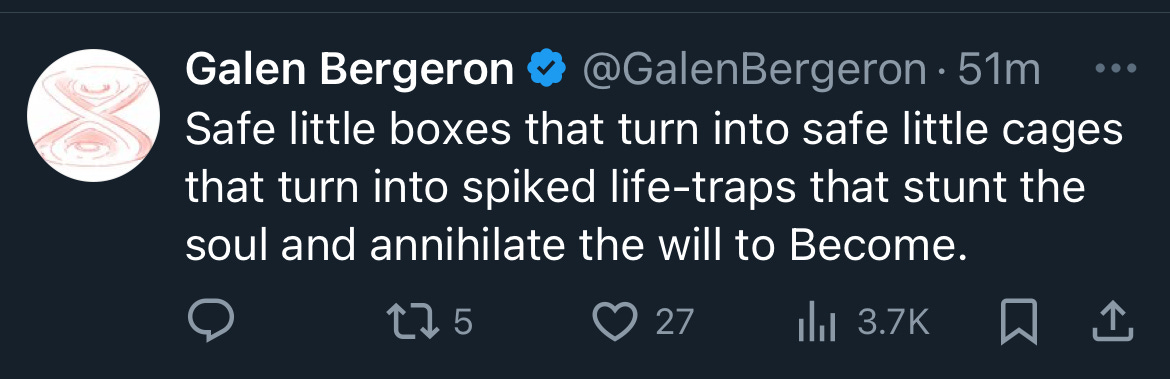
That’s something I’ve been trying to look out for recently, both in myself and others. Who is actually applying the lesson and feeling their feelings? Who isn’t afraid of facing pain, or at least, is assured enough to know that they can rebuild after everything crumbles? Who is genuinely happy, instead of just telling people that they are?
While I can’t make sense of hypocrisy, predatory behavior, and pretentious English professors who weaponize wise words, I can use all of this to assess what I’m doing in my own life. I can combat those nasty feelings of betrayal by building my own sense of integrity and wholeness.
I can show up for myself more consistently. I can have my words carry weight. I can feed myself and stay soft and keep my palms up. I can make space for all my parts and internalize affirmations. I can believe in what I say, and not just have it be flowery noise.
Even in my dream scenario, where I unlock a guide for how to survive grief and how to receive all of life’s answers and how to become the smartest person on earth, the only way out is through. I just have to exist as is and do the fucking work at some point.
There’s this quote I love that I think summarizes it best: “Knowledge is just a rumor, until it moves through the muscle.”
May I love myself so fiercely, that my actions speak for themselves. An embodied lesson. A life fully lived.
Thank you for reading!!! If you’re new here, hi! I’m Esther! I’m a 27-year-old writer and content creator! My main job is running socials for a mental health nonprofit, Made of Millions. You can mostly find me making educational videos and cultural commentary on our TikTok.
I also want to mention that this post was NOT!! written or edited by AI. It all came from my Esther brain, including the em dashes I worked so hard to master in all my copyediting classes at school. If there’s errors or it sounds wonky, stop fearing my humanity.
That’s it for now! See you next week for more :)
Quote edited for clarity and brevity